Finding winged insects, debris, or damaged wood in your home can be alarming. Homeowners often mistake carpenter ants for termites because both pests can stay concealed within wall voids and structural wood.
The key difference is simple: carpenter ants excavate wood to create nesting galleries, while termites consume wood. Correct identification matters because the two pests leave different evidence and require different treatment approaches.
Across Upstate New York and Pennsylvania, carpenter ant activity is usually most noticeable from spring through summer, although colonies inside heated buildings may remain active during winter. Moisture-damaged wood around windows, doors, rooflines, sill plates, and plumbing areas can provide suitable nesting sites for carpenter ants.
Carpenter Ants vs. Termites: Key Differences
The easiest way to compare carpenter ants vs. termites is to examine the waist, antennae, wings, and evidence around damaged wood.
| Feature | Carpenter Ants | Termites |
| Waist | Narrow and pinched | Broad and relatively straight |
| Antennae | Bent or elbowed | Straight and bead-like |
| Wings | Front wings longer than rear wings | Four wings of approximately equal length |
| Wood activity | Excavate wood | Consume wood and cellulose |
| Common evidence | Frass and clean galleries | Mud tubes and mud in damaged areas |
Color can provide another clue, but it should not be used alone. Carpenter ants are commonly black, dark brown, or reddish. Termite workers are usually pale, while termite swarmers may be brown or nearly black.
Carpenter Ant Identification
Carpenter ants are among the largest ants commonly found around homes. Workers from the same colony may vary in size, but their segmented bodies, narrow waists, and bent antennae are reliable carpenter ant identification features.
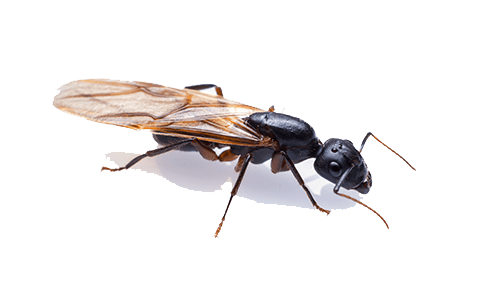
Most carpenter ants seen indoors are wingless workers. Mature colonies may also produce winged reproductive ants near windows, doors, basements, or attics. These winged ants still have pinched waists and elbowed antennae, with front wings that are longer than the rear wings.
Finding one carpenter ant does not always mean there is a nest inside the home. It may be a worker entering from an outdoor colony while searching for food. Repeated sightings, indoor swarmers, winter activity, or ants returning to the same wall or ceiling area are stronger warning signs.
Termite Identification
Termites have softer bodies and a more uniform shape than carpenter ants. They lack the narrow waist associated with ants, and their antennae extend straight from the head.
Termite workers are pale and usually remain hidden inside soil, mud tubes, or damaged wood. Homeowners are more likely to notice dark swarmers or piles of detached wings near windows, doors, or foundations.
Reliable termite identification should consider both the insect and the evidence found around the wood. Broad waists, straight antennae, equal-length wings, and mud tubes are important clues.
What Carpenter Ant Damage Looks Like
Carpenter ants do not eat wood. They remove it to create smooth nesting galleries and push wood particles and other debris out of the nest.
This material is called frass. It often resembles coarse sawdust or small wood shavings and may contain insect parts. A frass pile below a small opening can help reveal a hidden nesting area.
Other possible signs include repeated ant trails, faint rustling inside walls or ceilings, winged ants emerging indoors, and activity around windows, doors, rooflines, porches, decks, or damp wood.
Carpenter ant galleries are generally clean, smooth, and free of soil. Termite-damaged areas are more likely to contain mud or soil.
What Termite Damage Looks Like
Termites consume wood, so their damage may remain hidden below the surface. Eastern subterranean termites are the primary termite concern across New York and Pennsylvania.
They often build earth-colored mud tubes between the soil and wooden parts of a building. These tubes may appear on foundations, basement walls, support posts, sill areas, or framing.
Other signs include hollow-sounding or soft wood, mud inside damaged areas, discarded wings, dark swarmers, and blistered or uneven wooden surfaces.
The absence of visible mud tubes does not prove termites are absent. Their activity may be concealed behind walls, beneath flooring, or inside structural wood.
Why Moisture Matters
Moisture is an important clue, especially with carpenter ants. They often establish nests in damp or previously damaged wood because it is easier to excavate.
Common problem areas include leaking roofs, damaged gutters, plumbing leaks, damp crawl spaces, rotting trim, window frames, and porch supports. Outdoor colonies may also develop in stumps, logs, damaged trees, or landscape timbers.
Reducing moisture can make a property less attractive to carpenter ants, but repairing a leak does not automatically eliminate an established colony.
Why Accurate Identification Matters
Carpenter ants and termites require different control strategies. Spraying visible ants may temporarily reduce activity, but it may not reach a colony hidden inside a wall, ceiling, or structural void.
Effective ant control depends on locating nesting areas, following travel routes, identifying moisture problems, and targeting the colony rather than only the workers that are visible.
A professional inspection should focus on likely nesting locations, moisture-prone areas, exterior entry points, and established ant trails. The treatment approach can then be adapted to the ant species, nesting location, and conditions around the property.
Protect Your Home From Wood-Damaging Pests
The simplest distinction is that carpenter ants excavate wood, while termites eat it. Carpenter ants have pinched waists, elbowed antennae, and unequal wing pairs. Termites have broad waists, straight antennae, and wings of approximately equal length.
If you find winged insects, frass, mud tubes, or unexplained wood damage, do not rely on appearance alone. A professional inspection can identify the pest, locate areas of activity, and determine the appropriate next step.
EnviroPest serves homes and businesses throughout Upstate New York and Pennsylvania. Schedule a free pest inspection today.