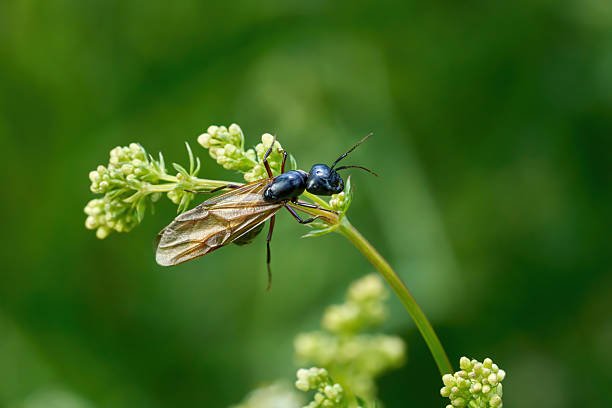
A queen carpenter ant is usually the largest and most heavily built ant in the colony. She has a narrow waist, elbowed antennae, a large abdomen, and a noticeably robust thorax. Before mating, a queen has wings. After mating, she sheds them and searches for a protected place to begin a new colony.
For homeowners in Upstate New York and Pennsylvania, seeing a queen carpenter ant is worth paying attention to, but one queen does not automatically mean there is an established colony inside the house. The season, location, and number of ants you see all matter.
How to Identify a Queen Carpenter Ant
Look at several features together rather than relying on color or size alone:
- Size: Queens are larger than workers and can reach roughly 3/4 inch, depending on the species.
- Body shape: The thorax is broad and muscular compared with a worker’s.
- Antennae: Carpenter ants have distinctly elbowed antennae.
- Waist: Their bodies narrow sharply between the thorax and abdomen.
- Wings: A reproductive female has two pairs of wings before mating. The front wings are longer than the rear wings. After mating, the queen removes her wings.
- Color: Black is common in the Northeast, but carpenter ants can also be dark brown, reddish, or a combination of colors.
If you are unsure which type of ant you are seeing, EnviroPest’s carpenter ant identification guide explains the basic features in more detail.
Queen Carpenter Ant vs. Worker vs. Termite Swarmer
| Feature | Queen Carpenter Ant | Worker Carpenter Ant | Termite Swarmer |
|---|---|---|---|
| Size | Usually the largest ant in the colony | Smaller; size varies | Size varies and can overlap |
| Waist | Narrow and pinched | Narrow and pinched | Broad |
| Antennae | Elbowed | Elbowed | Straight |
| Wings | Present before mating; shed afterward | None | Two pairs of wings |
| Wing length | Front wings longer than rear wings | N/A | Front and rear wings about equal |
| Body | Heavy thorax and large abdomen | Leaner body | More uniform body width |
The waist, antennae, and wing proportions are generally more useful than size alone when distinguishing a winged carpenter ant from a termite swarmer.
What Does Seeing a Queen Carpenter Ant Mean?
A single queen is not proof of an indoor infestation.
In the Northeast, mature carpenter ant colonies release winged reproductive ants during warm weather in spring and early summer. After mating, a queen drops her wings and looks for a suitable place to start a colony. One queen found near a door, window, porch, or other exterior entry point may simply have entered from outside.
The situation becomes more concerning when you notice:
- Multiple winged carpenter ants indoors
- Swarmers repeatedly gathering around windows
- Large ants emerging from the same wall, ceiling, or trim area
- Carpenter ant activity during cold winter weather
- Sawdust-like material, known as frass, below wood
- Discarded wings indoors
- Damp, softened, or water-damaged wood near the activity
If several winged ants are emerging indoors, read more about carpenter ants with wings.
Why the Season Matters in Upstate New York and Pennsylvania
Carpenter ants are common throughout the Northeast, and the black carpenter ant is a frequent household pest in this region. Homes near mature trees, wooded lots, old stumps, stacked firewood, and moisture-damaged exterior wood can have nesting sites nearby.
Spring and early summer are normal swarming periods, so an isolated reproductive ant during warm weather may have come from outside.
Winter is different. Outdoor carpenter ant activity drops substantially during cold weather. If large carpenter ants are repeatedly active inside a heated New York or Pennsylvania home during winter, that activity deserves closer inspection because a nest may be located in or close to the structure.
Moisture is another important clue. Carpenter ants do not eat wood like termites. They excavate wood to create nesting galleries and commonly take advantage of wood that has been softened by moisture or decay.
Common areas to inspect include:
- Window and door frames
- Rooflines, soffits, and flashing
- Areas around plumbing leaks
- Bathrooms and kitchens
- Crawl spaces and basements
- Porch supports and deck connections
- Wall voids near damp wood
EnviroPest also covers additional signs of carpenter ants in the home.
Is the Queen Necessarily Inside Your House?
No. Carpenter ants can maintain a parent nest and one or more satellite nests.
The parent nest contains the queen, eggs, and younger brood and is often associated with a moist nesting site. It may be outdoors in a hollow tree, stump, decaying log, or other damp wood.
Satellite nests can develop elsewhere, including inside buildings. These nests may contain workers and older brood even though the queen remains in the parent nest.
That means carpenter ants inside a house may be:
- Traveling from an outdoor parent colony
- Living in an indoor satellite nest
- Foraging for food or water
- Moving between multiple nesting locations
Finding the source of the activity is more useful than assuming the queen is located behind the nearest wall.
What Should You Do If You Find a Queen Carpenter Ant?
Do not focus only on killing the ant you can see. Instead:
- Photograph or save the ant so it can be identified.
- Note where and when you found it and whether it had wings.
- Watch for additional activity, particularly around the same part of the house.
- Check for frass, discarded wings, damp wood, and other signs of nesting.
- Look for moisture problems, including roof leaks, plumbing leaks, clogged gutters, condensation, and deteriorating exterior wood.
- Arrange an inspection if ants keep appearing, several swarmers are indoors, activity continues during winter, or you find signs of a nest.
Finding a queen carpenter ant is a reason to look more closely at what is happening around the home, especially if you are also seeing swarmers, frass, recurring indoor activity, or moisture-damaged wood. Because the queen may be part of a parent nest outdoors while workers or satellite nests are active inside, finding the source is more important than treating the ants you can see.
EnviroPest provides carpenter ant control for homes and businesses throughout Upstate New York, including Rochester and Albany, and Pennsylvania. If carpenter ant activity is continuing around your home, do not wait for the problem to spread. Contact EnviroPest to schedule a carpenter ant inspection and find out exactly where the activity is coming from and what needs to be done next.